
My goal isn’t just to help you feel well – it’s to help you age optimally, staying biologically younger than your calendar years. The AGE Scan is one of the most powerful tools I’ve added to do exactly that: a quick, painless test that reveals how your body is aging at the cellular level. This issue covers what it is, why it matters, and what you can do about it.
What Are AGEs – and Why Should You Care?
AGEs stands for Advanced Glycation End-products. They form when sugars in your body react with proteins or fats in a process called glycation – essentially a slow, internal “browning” reaction, similar to what happens when you toast bread or sear a steak. Unlike those foods, however, once AGEs form in your body’s tissues, they are largely irreversible.
AGEs accumulate throughout the body — in the arteries, kidneys, nerves, joints, eyes, skin, and brain. Over time they stiffen tissues, promote inflammation, impair cell signaling, and accelerate virtually every hallmark of aging and chronic disease. Elevated AGE levels are linked to:
• Heart disease and arterial stiffness
• Type 2 diabetes and insulin resistance
• Cognitive decline and Alzheimer’s disease
• Chronic kidney disease
• Premature skin aging, wrinkles, and loss of elasticity
• Sarcopenia (muscle loss) and reduced strength
Two sources drive AGE accumulation: your body produces AGEs endogenously (especially when blood sugar is elevated), and you consume them in your diet. Cooked animal foods – particularly those prepared with dry, high-heat methods like grilling, roasting, and frying – are one common high dietary AGE source.
How the AGE Scan Works
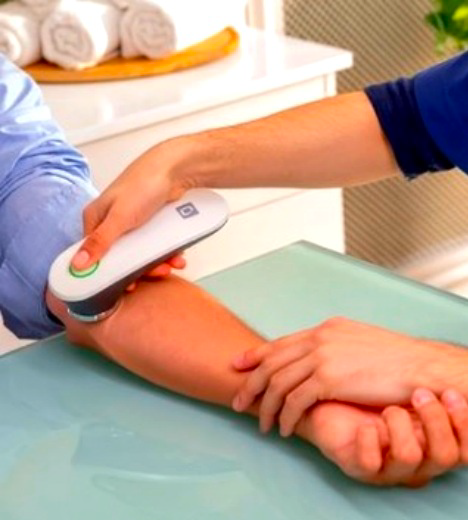
The AGE Scan uses a technology called Skin Autofluorescence (SAF). Certain AGEs, particularly fluorescent crosslinks like pentosidine, naturally emit light when exposed to a specific wavelength. The AGE Reader device shines a gentle beam of UV light onto the skin of your inner forearm and measures the reflected fluorescent signal. The result is a single SAF score. The test is not accurate on dark skin (Fitzpatrick skin types V–VI) .
Because collagen in the skin turns over very slowly, SAF reflects long-term, cumulative AGE accumulation – not just what you ate for breakfast. Think of it as a “running average” of your glycation burden over months and years, similar to how HbA1c reflects average blood sugar over 90 days, but capturing a much longer biological window.
“Higher dietary AGE intake was associated with higher skin autofluorescence — suggesting dietary AGEs directly influence tissue accumulation and disease risk.”
— Rotterdam Study, American Journal of Clinical Nutrition, 2020 · n = 2,515
The test takes about a minute. No needles. No fasting required. You simply rest your arm while the device takes the reading. The result is immediately available and placed in the context of age-matched reference ranges.
What Your Score Tells Us
SAF is reported in Arbitrary Units (AU). Research consistently shows that SAF increases with age in healthy individuals – but the rate of increase is not fixed. People with diabetes, kidney disease, cardiovascular disease, or poor dietary habits accumulate AGEs far faster than their chronological age would predict.
A SAF score significantly above the age-matched average is a meaningful signal. Large prospective studies have demonstrated that elevated SAF independently predicts:
• Cardiovascular mortality — more strongly than HbA1c or standard
cholesterol
• Development of type 2 diabetes in at-risk populations
• Progression of diabetic nephropathy and retinopathy
• Cognitive decline and dementia risk
Importantly, SAF is not simply a diabetes marker. It captures biological aging in everyone – including people with normal blood sugar – making it one of the most broadly useful non-invasive aging biomarkers available today.
Based on the research literature of more than 300 studies, here is a bullet list of conditions associated with elevated skin autofluorescence (SAF):
Metabolic & Cardiovascular
- Type 2 diabetes and prediabetes
- Insulin resistance and metabolic syndrome
- Cardiovascular disease and atherosclerosis
- Hypertension
- Dyslipidemia
- Coronary artery disease and increased risk of cardiac mortality
- Heart failure
- Peripheral artery disease
Renal
- Chronic kidney disease (CKD)
- End-stage renal disease / dialysis patients (markedly elevated SAF)
- Diabetic nephropathy
Neurological & Cognitive
- Alzheimer’s disease and cognitive decline
- Vascular dementia
- Mild cognitive impairment
Endocrine & Metabolic Bone
- Obesity and visceral adiposity
- Thyroid dysfunction
- Osteoporosis and reduced bone mineral density
Musculoskeletal & Connective Tissue
- Sarcopenia (muscle loss and reduced grip strength)
- Rheumatoid arthritis
- Stiffening of tendons, joints, and cartilage
Ocular
- Diabetic retinopathy
- Age-related macular degeneration
- Cataracts
Skin & Dermatological
- Premature skin aging, loss of elasticity, and wrinkle formation
- Psoriasis (associated with systemic AGE burden)
Lifestyle & Environmental Exposures
- Smoking (major independent driver of elevated SAF)
- Ultra-processed food consumption
- Sedentary lifestyle
- Chronic sleep deprivation and psychological stress
General Aging
- Biological aging acceleration (SAF rises with age but faster in disease states)
- Frailty and reduced functional capacity
- All-cause mortality risk
SAF is notable as a cross-cutting biomarker – it predicts adverse outcomes across multiple organ systems because glycation damage is a shared mechanism underlying aging and most chronic diseases.
What Raises Your SAF Score?
Dietary factors:
• High intake of grilled, roasted, fried, or ultra-processed foods
• Excess dietary sugar, refined carbohydrates, and sweetened beverages
Metabolic and lifestyle factors:
• Elevated blood sugar
• Smoking (a major independent source of exogenous AGEs)
• Oxidative stress and chronic inflammation
• Reduced kidney function (impairs AGE clearance)
How to Lower Your AGE Burden
The good news: AGE accumulation is modifiable. Studies show that targeted dietary and lifestyle changes can measurably reduce SAF accumulation over months. Here is what the evidence supports:
Proven Strategies to Reduce AGE Accumulation
✓ Switch to moist, low-temperature cooking methods: steaming, poaching, slow-cooking, stewing
✓ Eat more plant foods: fruits, vegetables, legumes, and whole grains are naturally low in dietary AGEs
✓ Reduce added sugars and refined carbohydrates to lower endogenous glycation
✓ Use acidic marinades (lemon juice, vinegar) before cooking — they inhibit AGE formation
✓ Increase polyphenol-rich foods: green tea, berries, turmeric, and dark leafy greens block AGE-receptor activation
✓ Quit smoking: one of the highest-impact interventions for lowering exogenous AGE exposure
✓ Optimize blood sugar: even modest improvements in fasting glucose and insulin resistance reduce AGE formation
✓ Consider targeted supplementation: lactoferrin, carnosine, benfotiamine, and alpha-lipoic acid have documented anti-glycation activity
We can combine your SAF score alongside your full functional medicine assessment – including metabolic labs, inflammatory markers, and dietary analysis – to build a personalized anti-AGEing plan. Serial measurements allow us to objectively track whether interventions are working.
Schedule Your AGE Scan
The AGE Scan takes less than one minute and requires no preparation. It is available to all patients at the Debé Center and pairs naturally with our Anti-AGEing Nutrition Analysis program, which uses AI-assisted dietary analysis to estimate your AGE intake and guide personalized food choices.
To schedule your scan or learn more about our Anti-AGEing program, call us at 516-829-1515, visit www.drdebe.com, or ask at your next visit. We look forward to helping you see – and lower – your biological age.
For more about AGEs, read my article: You Are What You Eat, So Don’t Eat Crust: Will Strategies to Suppress Advanced Glycation End Products(AGEs) Prove to be Our “Fountain of Youth”?